
how-to-make-your-first-1m-with-ai-in-2026-the-full-playbookmd
15,664 chars · 3,916 tokensUTF-8 · LF
# How to Make Your First $1M With AI in 2026: The Full Playbook
---

The next three years will create more millionaires than the internet did in two decades. And 90% of the people watching it happen will completely miss it.
Not because they lack access to the tools. Everyone has access now.
They'll miss it because they're going to chase every shiny AI thing they see instead of picking one direction and dominating it. They'll bounce between crypto bots, automation agencies, content monetization, AI image businesses, and consulting until they wake up in 2028 and wonder where the window went.
This article is about the actual path.
The version nobody on X is selling because it's not viral. The version that's worked for the 257 people my team and I have mentored through this exact transition over the last six months. The ones making money aren't smarter, faster, or more technical. They just understood three things the other 90% never figure out, and they ran straight into the GTM lane while everyone else was busy reinventing the wheel.
Why this AI window is shorter than every other tech wave
Every major technology has a window where early operators capture insane advantages. After that window closes, you're competing on price.
The telegraph took 56 years to hit 50% adoption. The internet did it in 7, smartphones in 5. AI is on track to hit 50% in 3 years, and we're already at 88% of businesses using it in some form. The gap right now is between adoption and execution. Most companies have ChatGPT subscriptions and zero idea how to turn that into pipeline, operational leverage, or revenue. That gap is the entire opportunity, and it's closing fast.
We built ColdIQ to $7M+ ARR in under three years on the back of this exact GTM gap. We saw what AI could collapse in cold outreach before most agencies caught on, and we stayed focused while the market was sprinting in five directions. The companies that hesitated are now competing for the leftovers.
Look at every previous wave.
Ecommerce had a window from 1995 to 2005. Mobile from 2007 to 2014. Facebook organic reach went from nearly 100% to under 1% by 2018. The people who weren't in early missed the entire opportunity, not a small slice of it. In 12 to 18 months, the AI GTM playbooks are going to be public, the prices will compress, and the race to the bottom will start. Right now there's still oxygen in the room.
The trap that catches 90% of people
Every week there's a new AI tool, a new automation, a new business model. The noise is constant and it's not slowing down. The trap is mistaking "keeping up" for "making progress."
People feel productive while watching tutorials, testing tools, signing up for newsletters, joining communities, and bouncing between business ideas. They look busy from the outside and broke from the inside. Because you don't hit your first million by running five experiments at once.
The people you see online making seven figures for the first time picked one lane 5 years ago and never looked back. Gladwell's 10,000-hour rule didn't get repealed by AI. You hit mastery in one direction, not five. And mastery is what pays. You need one problem you can solve better than anyone in the world. Not three, not five. One. Then you solve it a thousand times, mess up a hundred of them, and refine until your version of the solution is twice as good as the next operator's.
Carnegie figured this out 150 years ago
In 1870 the steel revolution was exploding. Every entrepreneur with capital was trying to control the entire chain. Iron mines, coal mines, railroads, production plants, distribution networks. The conventional wisdom was that whoever controlled the most pieces would win.
Andrew Carnegie sat down and counted the steps. There were 12. Everyone was chasing all 12.
He picked one. Production.
His partners thought he was crazy. The real money is in the mines, they argued. The railroads are where the leverage sits. Carnegie's answer was simple: every dollar, every hire, every innovation, every improvement goes into making better steel cheaper than anyone else in the world.
In 1875, steel cost $100 a ton. By 1900, Carnegie was producing it at $12 a ton. Nobody could compete. He sold the business to JP Morgan in 1901 for $480 million and became the richest man in America.
He never owned the mines or the railroads. He owned one part of the chain so completely that the rest of the industry had no choice but to come to him.
That's the model for the AI era.
Don't try to control "AI." Pick the one thing AI lets you deliver faster, better, and cheaper, and dominate it until the second somebody thinks of that problem, they think of you.
The GTM opportunity hiding in plain sight
Businesses have 3 problems they pay to solve. Saving money, saving time, and making more money.
A company can survive tight margins for years. It can run inefficiently for a long time too. The one thing it cannot tolerate is going without customers. That's why "making more money" is the most urgent of the three, and it's where the biggest budgets sit. Within that category, every CEO is quietly asking the same question: how do I get more people who actually want to buy from me?
That's GTM.
Lead generation, signal-based outbound, pipeline creation, the whole motion of putting offers in front of buyers who are ready to move. And right now it's the cleanest entry point into the AI era for anyone starting without capital, a technical team, or an existing audience. Business owners pay us four to five figures every month to solve this exact problem. The economics work because AI just collapsed the cost of delivering it.
The cost collapse of starting an agency
5 years ago, starting a GTM agency required serious capital. $15K to $25K per person per year in tools alone. A team of researchers, analysts, outreach specialists, and copywriters. Software subscriptions like Zoom Info and Salesforce ran into six figures annually. You needed the team to land clients, and you needed the clients to afford the team. Most people couldn't crack the loop.
Today the loop is broken.
Tools that used to cost six figures a year now cost $200 to $500 a month. A list of 500 qualified prospects that used to take days of manual research now takes hours with Clay, Apify, and the right enrichment stack. The barrier to entry didn't drop. It collapsed.
But 80% of new agency builders are still getting it wrong. They're using AI to do more of the same garbage faster. They're blasting 10,000 contacts with generic AI-generated messages and watching reply rates land under 1%. 46% of global email is now flagged as spam. Volume as a strategy is dead.
We've sent over 23 million cold emails across ColdIQ's client campaigns. The campaigns that consistently book meetings use 8 to 12 data points per lead before the first email goes out. 200 high-intent prospects with deep personalization beats 10,000 lookalikes every single time. The market is rewarding GTM depth and punishing volume harder than at any point in the last decade.
What one person with AI actually replaces
This is the number that closes deals.
A typical mid-market B2B company runs five SDRs in-house for prospecting and outreach. Base salary is around $50K. Once you add benefits, taxes, tools, training, and management overhead, the fully loaded cost lands at $80K to $130K per SDR per year. Five of them runs the company $400K to $650K annually just for that one function.
One operator with AI and the right GTM frameworks can deliver the same prospecting output as those five SDRs.
We charge clients $3K to $10K a month for this work, which is $36K to $120K a year. The client saves $280K to $614K annually depending on team size and seniority. Their cost on the prospecting function drops 70 to 90%, and the output is often better because AI-augmented operators don't burn out, don't lose context between conversations, and don't go on vacation.
That's not an incremental improvement. The unit economics are completely different now. It's why companies sign without flinching when you put the proposal in front of them. The number speaks for itself.
The exact GTM service you're selling
Most people freeze on "what do I even sell?" so let me make it concrete. The service is signal-based lead generation, delivered end-to-end. Five components, no more.
1. ICP definition.
Before you touch a tool, you sit with the client for a working session and define exactly who they sell to. "B2B SaaS founders" is too broad to be useful. You want something like "Series A SaaS companies in fintech, 30-100 employees, that hired a Head of Sales in the last 90 days." Tight ICPs are where everything else either works or breaks.
2. List building with signals.
This is where Clay, Apify, PredictLeads, Common Room, and the signal stack do the heavy lifting. You're building a fresh list every week from triggers: job postings, funding events, tech stack changes, hiring shifts. 200 to 500 high-intent leads, not 10,000 lookalikes.
3. Enrichment and personalization layer.
Each lead gets 8 to 12 data points pulled before any email is written. Recent posts, company news, specific role context, the trigger that put them on the list. This is the part 80% of new agencies skip, which is exactly why they get sub-1% reply rates.
4. Multi-channel outreach.
Cold email through Smartlead or Instantly, paired with LinkedIn touches through HeyReach or La Growth Machine. A 4-email sequence is the optimal length. 30 to 50 sends per inbox per day max if you care about deliverability. Personalized intro line per lead, generic body that the data still informs.
5. Booked meetings handed to their calendar.
Replies get qualified, meetings get scheduled directly into the client's calendar, and you report weekly. The client never touches the prospecting machine. They just take the calls.
That's the entire offering. 5 steps, one operator, AI doing the work that used to take 5 SDRs. When you write the proposal, those five steps are exactly what the client is buying. The price tag depends on volume, but the structure stays the same whether you're charging $3K or $10K a month.
How to actually get your first 3 clients
Most people freeze here. They understand the opportunity, they know they should move, and they get stuck consuming more content. Another course, another video, another newsletter. They tell themselves they need to "be ready."
You're never going to feel ready. The only thing that makes you ready is having clients and learning to deliver under pressure. Consuming content feels like progress, but it's procrastination wearing productivity's clothes.
You don't need 100 clients to validate this. You need one. And you find them in three places. Your existing network, industries you've worked in before and already understand, and niches small enough that the rest of the market is ignoring them. Don't try to outcompete agencies for "B2B SaaS." Pick veterinary practice management software, specialty manufacturing, or boutique law firms. Niches with money that AI Twitter has never heard of.
The offer that gets you the first yes is performance-based. "I'll get you results, or you don't pay." You eliminate the prospect's risk completely. The worst case for them is that nothing changes, and the upside is your GTM output beating their current numbers.
Here's why this works in 2026 in a way it didn't 5 years ago.
Your cost to deliver is near zero. With Clay, AI enrichment, and modern outreach platforms, you can do in 4 hours what used to take 40. You can afford to take the risk because you're not bleeding cash to fulfill the work.
Your first client will be chaos. You'll mess up the campaigns, the reporting, the deliverability, the targeting. You'll learn which tools actually work and which ones are hype. Your second client will be 30% less chaotic because most of your initial mistakes won't repeat. By client three, you have a system you can run with predictable results.
Each of those clients paid you to learn. That's the difference between operators who make it and operators who don't. The ones who make it build while everyone else is still studying. What clients actually want is someone obsessed with getting better every single week. That's the deliverable.
The timeline nobody on X is honest about
"Six months to six figures." "Quit your job in 90 days." "Get rich quick with AI."
For about 10% of operators, that's actually possible. For the other 90%, it's a lie that causes them to quit four months in, right before they would have started winning. We hit $7M ARR in 31 months and that's considered fast.
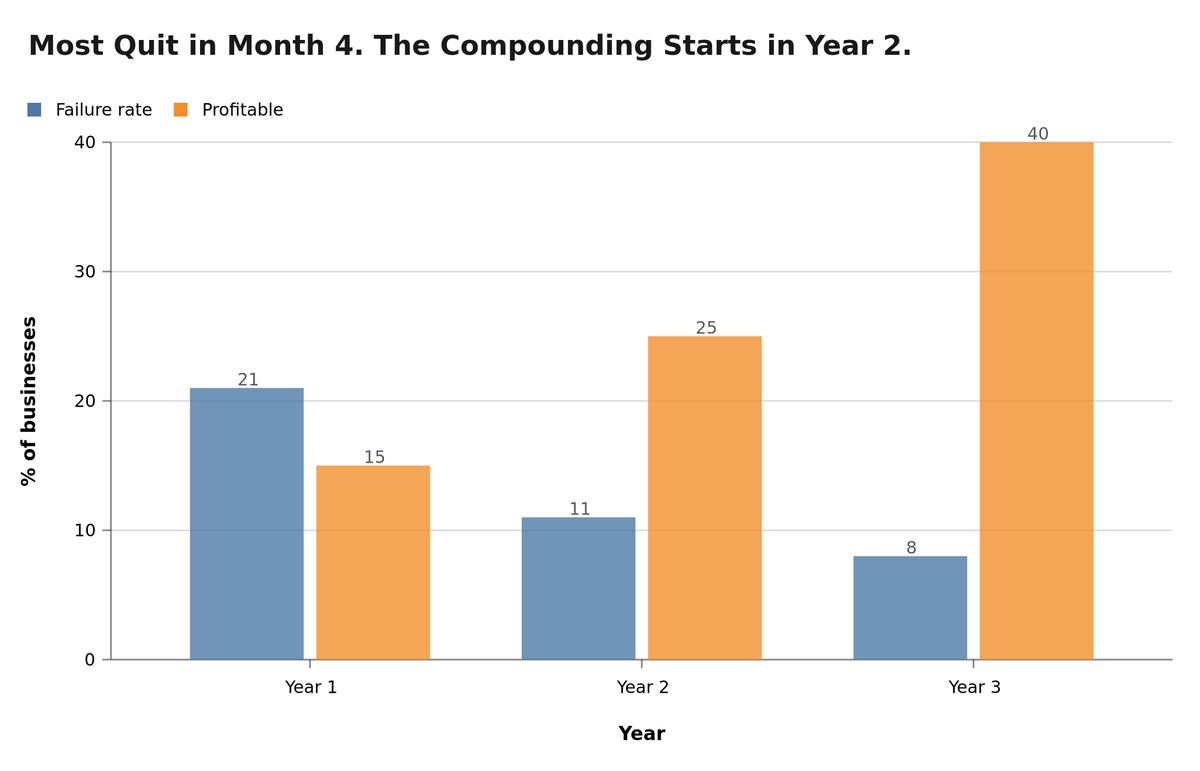
Year one was survival and learning. Year two was when things started compounding.
The data backs this. Only 15% of businesses are profitable in year 1. Another 40% become profitable in year 2 or 3. The failure curve is brutal in year 1 at 21%, drops to 11% in year 2, and drops again to 8% in year 3. Every year you survive, your odds of long-term success go up dramatically.
But most people quit in month 4. They read "six months to six figures," panic when they're not there yet, and walk away. They never see what month 14 would have looked like.
Reset the question.
Instead of "why is this taking so long?" ask yourself "am I sharper than I was 7 days ago?" If yes, you're on the path. If you're learning, adjusting, and getting better, you're exactly where you should be. The math takes care of itself from there.
The decision filter for everything new
Every day you'll be tempted to chase something. A new tool, a new model, a new AI agent that promises to replace your entire stack. A new business model someone is pitching on a Saturday morning thread.
None of it is bad. Almost none of it is your problem right now.
Use one filter for everything: does this move me closer to dominating the one GTM problem I picked? If the answer isn't a clean yes, the answer is no. A new enrichment tool that improves your lead targeting? Yes. AI-assisted day trading? Different category, different lifetime, walk away.
Your brain confuses novelty with progress. They're not the same thing.
Boredom is what mastery actually feels like. Running the same workflow a thousand times, sharpening every step, learning what breaks at scale and what compounds, that's the unsexy work nobody films for content. Excitement is jumping to a new opportunity every 3 months. The boring path is the one that compounds into real wealth.
The window is open right now
The AI window is real. It's open today.
It's not going to stay open forever, and the operators who use the next 18 months to build something focused, deep, and operationally tight are going to look untouchable when the rest of the market wakes up at the same time.
You don't need to be early to AI anymore. That window already closed.
You need to be focused. Pick one GTM problem businesses pay to solve. Get good enough at it to charge real money, then take your first three clients on performance to remove their risk. Reinvest everything you learn into making the system tighter, the delivery faster, and the output better than anyone else doing it.
That's the entire playbook. The reason 90% will miss it isn't that they don't know it. It's that they refuse to sit still long enough to execute it.


ref · hEPDPRkxxmdbot.com/c/hEPDPRkx