how-to-build-your-content-system-with-ai-and-get-to-5m-impremd
16,145 chars · 4,036 tokensUTF-8 · LF
# How to build your content system with AI (and get to 5M impressions)
---

a system that finds your ideas, drafts them in your voice, publishes them, and learns from what works. it took my account to 5M impressions in 2 weeks and 100K bookmarks in 2 months.
content is only as good as the person and the system behind it. low effort going into curating ideas and writing means low-quality content coming out the other side.
this article gets you started on building your own content moat.
I built a system that optimises for one thing:
> bookmarkable content
a kind of post that screams enough VALUE for a reader to click the bookmark button and add it to their second brain for reference.
Example of my 1 million impression post:
what you'll get from this article
every section here is something you can copy, adapt, and put to work on your own account this week.
the full Content OS framework, mapped to actual folders you can build today
four production-grade prompts you can paste straight into claude or any frontier model and start shipping
the V1 starter, 1-2 hours of upfront work that saves you those hours every week after
the writer context packet template that turns vague briefs into specific drafts
results before theory
I run my personal X account. before this run, the account had a name attached and a few thousand followers, but I was barely paying attention to it.
there was nothing in place worth calling a system. just sporadic posts that did sporadic numbers.
then I sat down and built the system in this article.
5M impressions in 2 weeks, from an account that had been near silent. iterated weekly since. by month two the same account passed 11M views and 100k bookmarks.
I co-founded @LunarStrategy , where we deploy a similar Content OS for our clients.
the non-negotiable
before any of the mechanics, the rule the whole system runs on:
never publish unedited, hand-finish every draft. the system is an accelerator, not autopilot. used as automation, it decays.
the goal is not to fake a voice from prompts. its to build a reusable operating asset from your real writing. do the work once, keep it current, and every draft the model produces will start closer to you, so your time goes into sharpening ideas.
what "bookmarkable" actually means
a bookmark is a small promise the reader makes to their future self. it says "I will need this again." that is a much higher bar than a like, and it behaves differently in the algorithm too.
I´m not going to overstate the ranking math, but as an marketer running this every week the pattern is consistent. bookmarks are a vote on future utility, and posts that earn them keep showing up in feeds long after the post date.
before I ship anything, I ask whether the post looks like one of these:
- a checklist
- a blueprint
- a folder structure
- a template
- a framework
- a step-by-step workflow
- a proof screenshot with a takeaway
- a before and after
- a reusable mental model
if a draft does not resemble any of those, it usually shouldn´t be published.
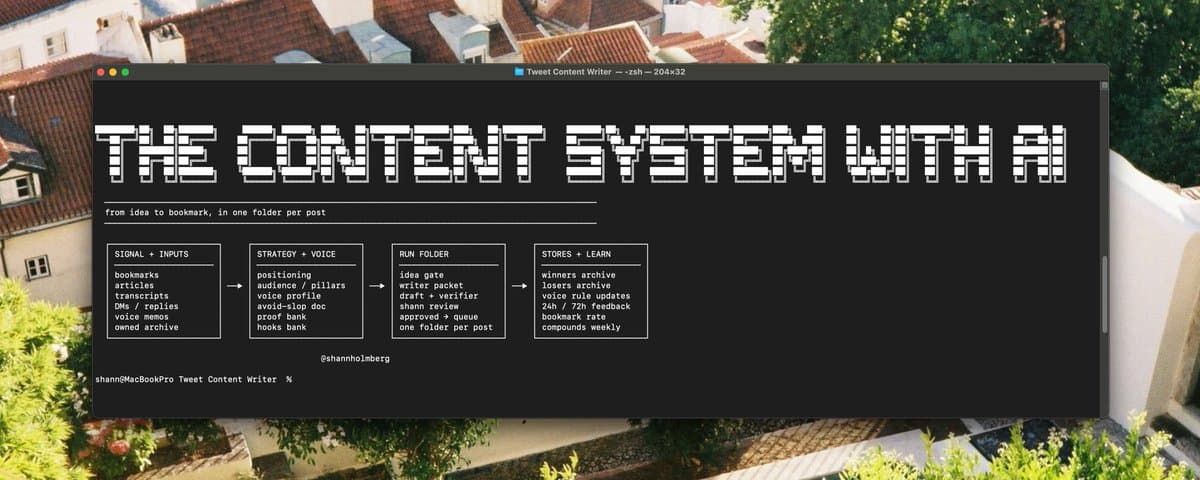
the system, in one diagram
I dont run a single mega-prompt and I dont run a stack of generic folders. I run a system built around one idea: every piece of content is an object that carries its own state from idea to published.
context lives in two places.
the signal layer is everything external you bring in: bookmarks you saved this week, content from the creators on you monitor list, an article you liked.
knowledge graph is everything internal you already own: your personal OS, notes, journals, voice memos, and the archive of content you´ve already shipped.
the route decides which source feeds the brief, and strategy + voice + stores sits between both and the writer so context is curated.
every post, article, thread, or campaign opens as a new run folder. that folder is the content object. it pulls from the shared parts of the system, moves through a lifecycle of gates, and writes its learnings back when it ships.
the lifecycle of one content object:
what sits around the run folder:
strategy. positioning, audience, pillars, source watchlist. the only layer I edit by hand. if you let an AI write your positioning, you do not have positioning. you have averages.
voice. voice profile and master avoid-slop document. read by every agent before it drafts a single line.
stores. inbox for raw inputs, workboard for what needs attention, ideas backlog, hook bank, proof bank, feedback log. the shared memory the run folder reads from and writes back to.
modules. the writer skill (SKILL.md, references, templates). the production code. one module per role you give the system.
workflows. the playbooks that move a content object through its states: idea-to-published, verifier checklist, scheduler handoff, feedback loop.
the four routes
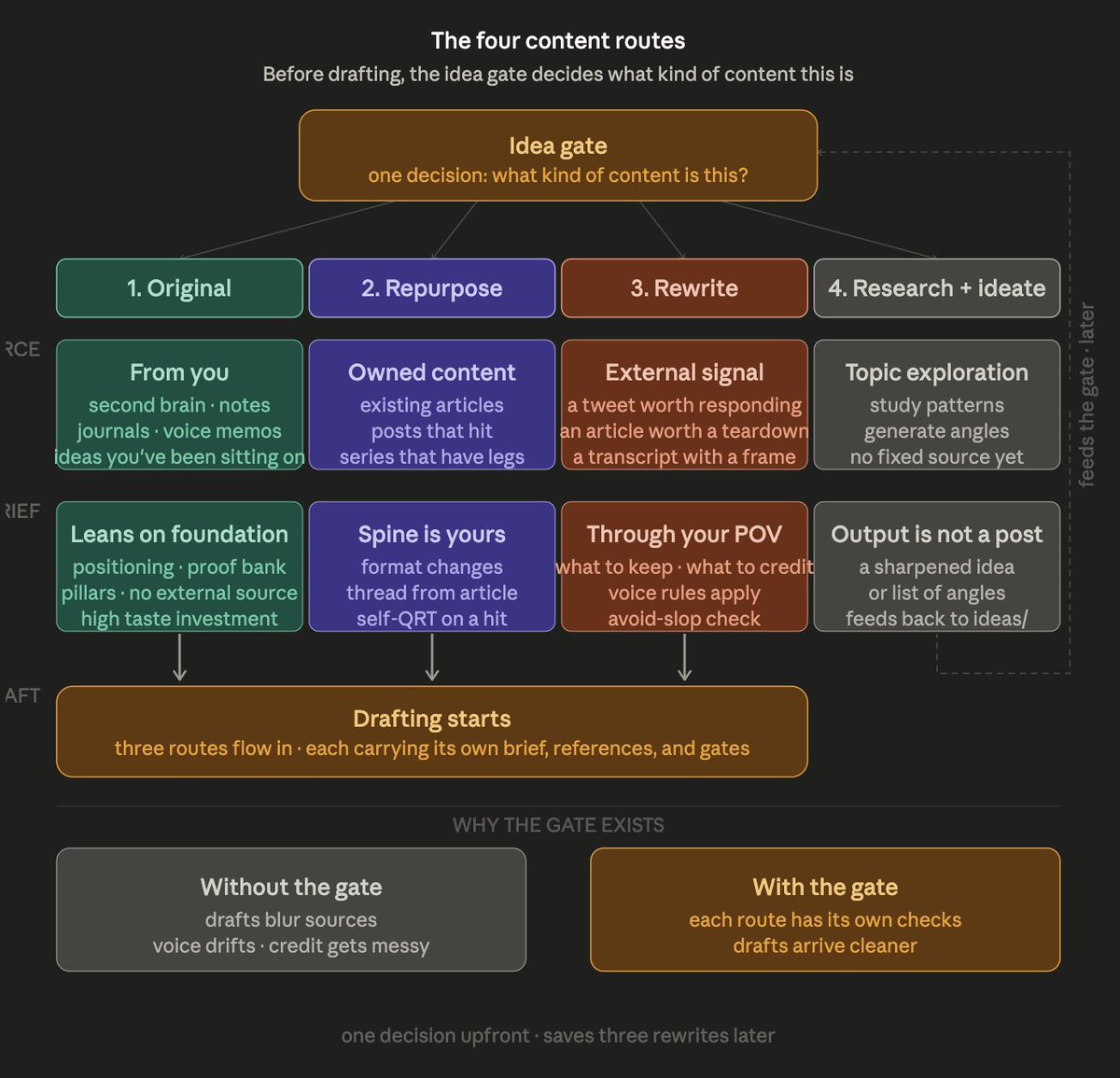
before a content object enters drafting, the idea gate makes one decision: what kind of content is this?
four routes, each with its own brief, its own references, and its own gates:
ORIGINAL. create something drawn directly from you or from your second brain (personal OS, notes, journals, voice memos, ideas youve been sitting on for weeks). the brief leans on your foundation: positioning, proof bank, pillars. no external source. high taste investment.
REPURPOSE. take owned content and extend it. a content series spinoff, a thread spun out of one of your articles, a self-QRT on a post that hit, or tweets that pull a single line from a piece youve already shipped. the spine is yours. the format changes.
REWRITE. take external source material from the signal layer (a tweet worth responding to, an article worth a teardown, a transcript with a useful frame) and translate it through your point of view and voice. the brief is explicit about what to keep, what to credit, and which voice rules apply (per the master avoid-slop document).
RESEARCH + IDEATE. explore a topic, study patterns, generate candidate angles before any drafting starts. the output is not a post. it is a sharpened idea or a list of angles that feed back into stores/ideas/ for later production.
each route still produces one run folder, with the route declared in content-object.md:
what came before this
before the current Content OS, I built a 4-agent system that ran a version of this same loop: researcher, idea maker, writer, and an orchestrator routing between them. each agent had its own memory that persisted across sessions.
I built the whole thing in claude code, with markdown prompts, a database, and CLI tools.
it worked. but it was overbuilt. four agents for what is, structurally, three production steps and a feedback loop. running it taught me what most blog posts on agent swarms left out:
> the agent count was not the lever. the knowledge layer feeding the writer was.
the current setup is the leaner version. fewer agents, more workflows, the same loop, sharper output.
the folder you can build today
you do not need fancy infrastructure to start. you need a directory that holds the shared parts and a place where each content object lives until it ships.
mine looks like this:
runs/active/ is the heart. each folder in there is one content object. one piece of content equals one run folder, and that folder carries its own state until it ships and gets archived.
notion, obsidian, a git repo, a shared drive. whatever you already use. the shape matters more than the tool.
your V1 setup
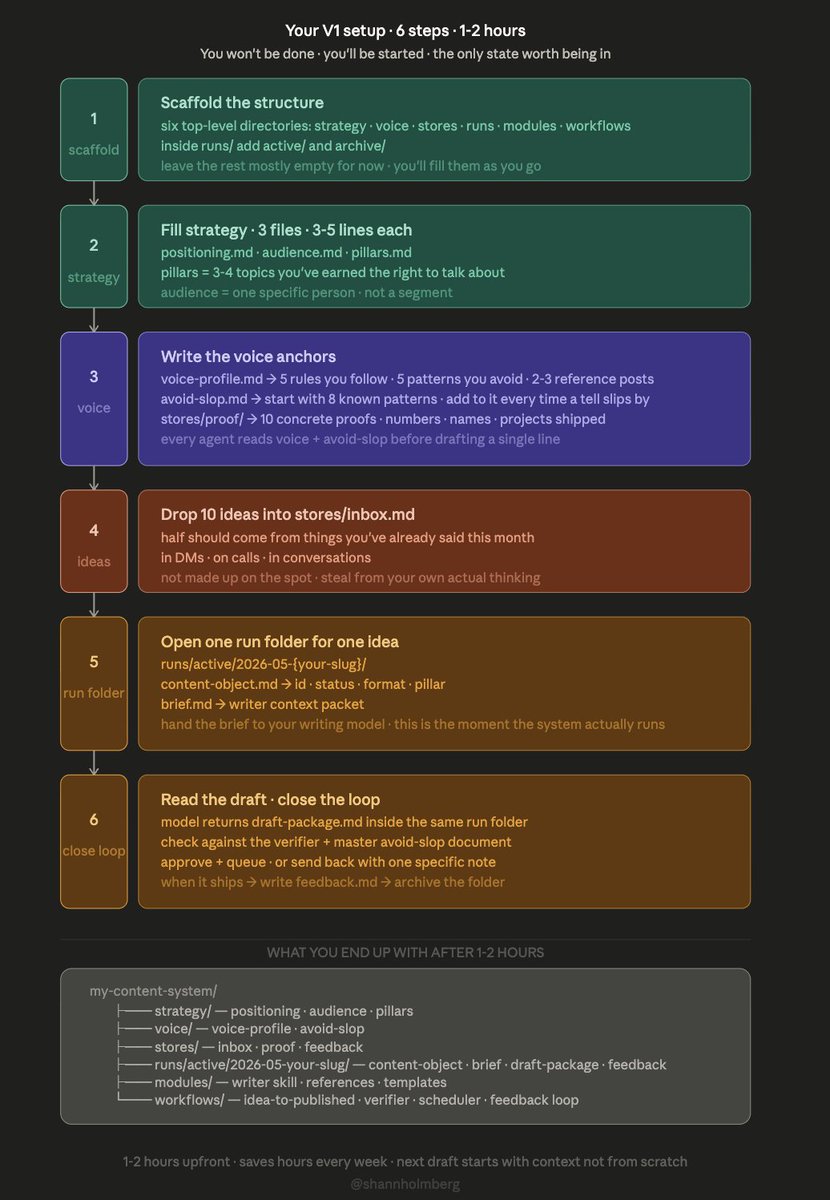
plan for 1-2 hours of upfront work. you wont be done. you will be started, which is the only state worth being in. the time you spend here pays back in hours saved every week after, because the next draft starts with context instead of from scratch.
step 1. scaffold the structure. create six top-level directories: strategy, voice, stores, runs, modules, workflows. inside runs, add active/ and archive/. leave the rest mostly empty for now.
step 2. fill strategy. open strategy/positioning.md, strategy/audience.md, and strategy/pillars.md. three to five lines each. pillars are the three or four topics youve earned the right to talk about. audience is one specific person, not a segment.
step 3. write the voice anchors. drop voice/voice-profile.md (5 rules you always follow, 5 patterns you never use, 2-3 reference posts that sound like you on your sharpest day) and start your own voice/avoid-slop.md (use the eight patterns from the section below as a starting filter, add to it every time a draft slips a tell past you). put ten concrete proofs in stores/proof/, things like numbers, names, projects youve shipped, lived examples.
step 4. drop ten ideas into stores/inbox.md. half should come from things youve already said in DMs or calls this month, not made up on the spot.
step 5. open a run folder for one idea. create runs/active/2026-05-{your-slug}/. inside it, write content-object.md (id, status, format, pillar) and brief.md (the writer context packet template, below). hand the brief to your writing model.
step 6. read the draft and close the loop. the model returns draft-package.md inside the same run folder. check it against the verifier and the master avoid-slop document. approve and queue, or send it back with one specific note. when it ships, write feedback.md and archive the folder.
the writer context packet
this is the part most people get wrong. they dump the whole brand doc, the whole knowledge base, and the whole feed into one prompt.
model writes safe mush because nothing in the context is load-bearing. a tight packet beats a giant context window almost every time.
packet lives inside the run folder as brief.md. one packet per content object, written before drafting starts.
copy this template:
the bookmarkability rubric
before a draft goes near the schedule, score it. zero, one, or two points each:
saves the reader a future task
includes proof (numbers, screenshot, named example)
gives a reusable takeaway (template, checklist, frame)
has a specific audience and job-to-be-done
can be applied without me being in the room
has a strong screenshot or visual
out of 12. my personal bar is 8. below 8 it goes back to the packet, not to the trash. most "bad" drafts are good drafts that skipped a row in the rubric. fix the row, re-score, ship.
this rubric is also the cheapest way to train new collaborators. you dont have to teach taste in the abstract. you hand them the rubric, point at three winning posts, and let the score do the talking.
the master avoid-slop document
the rubric tells you if a post is worth saving. the avoid-slop document tells you if a post sounds like a person wrote it.
I run every draft through one document before it ships. its 54 patterns, broken into three severity tiers, with concrete rewrites for each. it catches things like:
this is the document my writer agent loads before drafting and my verifier loads before approval.
its the difference between "AI wrote this" and "a person who happens to use AI wrote this."
im still working on a the full version inside the system for now, but the eight patterns above are enough to start filtering most slop out of your own drafts.
four prompts you can copy
short, scoped, and meant to be edited. treat them as starting shapes, not magic spells.
each one maps to one layer of the system. drop them into claude, gpt, or whatever frontier model you use. if you only keep one, keep the postmortem one at the end.
----
---
---
this last one is the highest-leverage prompt in the system. the model cannot say "strong hook" or "great insight."
it has to point at exact lines. most drafts that pass the verifier still fail this prompt, and the gap between the two is where the real edits live.
here is what it looks like running on this article:
two models, two roles
once I started running the system at volume, I hit something obvious in retrospect:
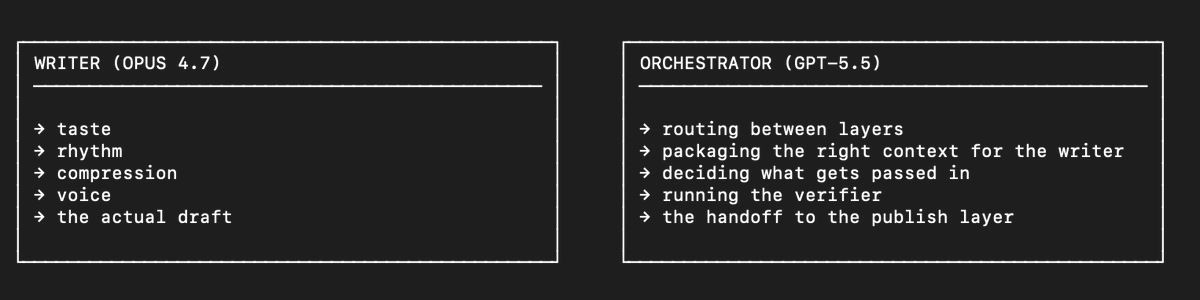
the job of writing and the job of running the system are different jobs, and they reward different models. so I stopped using one model for everything.
the split looks like this for me right now:
writer (opus 4.7) handles:
- taste
- rhythm
- compression
- voice
- the actual draft
orchestrator (gpt-5.5) handles:
- routing between layers
- packaging the right context for the writer
- deciding what gets passed in
- running the verifier
- the handoff to the publish layer
where to run the system
a system like this only works if the orchestrator can do the work. it needs to read and write files, call tools, run checks, and hand approved drafts to the publish layer on a schedule. so the real question is not which app you use, its where the system lives.
two setups I have seen work cleanly.
1.the first is a VPS with claude code.
you rent a small server, put your /content-os folder in a git repo, and let claude code run the workflow on it. you get full control, a machine you own, scheduled jobs for the weekly review, scripts for the verifier, and an AI coder that can touch the same files you do. this is the route if you like owning the stack and youre comfortable on a server.
2. the second is hermes agent, which is what I run.
its built for this shape of work: agents, skills, tool access, file and git operations, browser and search, scheduled jobs, and context that persists across the whole workflow. point it at your foundation, your inputs, and your packet template, and the orchestration layer carries the load between steps so I can spend my time on the writing and the edit. drafts still come to me before anything ships.
neither is required. the principle is what matters: host the system somewhere your orchestrator can read and write your files, call the tools it needs, run the verifier, and hand approved posts off to postiz. pick whichever of those two fits how you like to work.
Postiz as the publish layer
once a draft is approved, it goes into Postiz and gets queued.
one place to schedule across X, linkedin, instagram, threads, tiktok, youtube, bluesky, reddit, and more.
open source and self-hostable, repo is gitroomhq/postiz-app, built by @wickedguro
Postiz is where I let agents touch social, it's the framework that lets my agent publish & schedule content across multiple channels.
Try it out here: https://postiz.com/
the feedback loop is a moat
most people stop at publish. that is where the system starts earning.
every week I look at:
- views
- bookmarks
- bookmark rate
- replies
- DM follow-ups
> bookmark rate is the one I watch most. it tells me which posts earned the save, not just the scroll.
winners get copied into inputs as examples next to their numbers. losers update voice rules, banned patterns, or the idea filter.
the next packet gets sharper because of what I learned this week.
the blueprint
Im packaging the full system as a blueprint on a new site im building called bookmarkable.
the actual folder structure, the prompts I run, the writer context packet template, the verifier checklist, the rubric, the master avoid-slop document, and the files I use on my own account.
be first to know when this system blueprint gets released: https://bookmarkable.io/
if you already have drafts youre happy with and the part youre missing is the publish layer, dont wait on me.
Go start using Postiz now. It's the same tool I plug into the back of this system, it will queue your approved posts across every channel that matters, and you can wire the rest of the stack around it as you build it.
https://postiz.com/ - Thank you to the Postiz team for collaborating on this article.
-- shann





ref · qwa6VK83xmdbot.com/c/qwa6VK83